
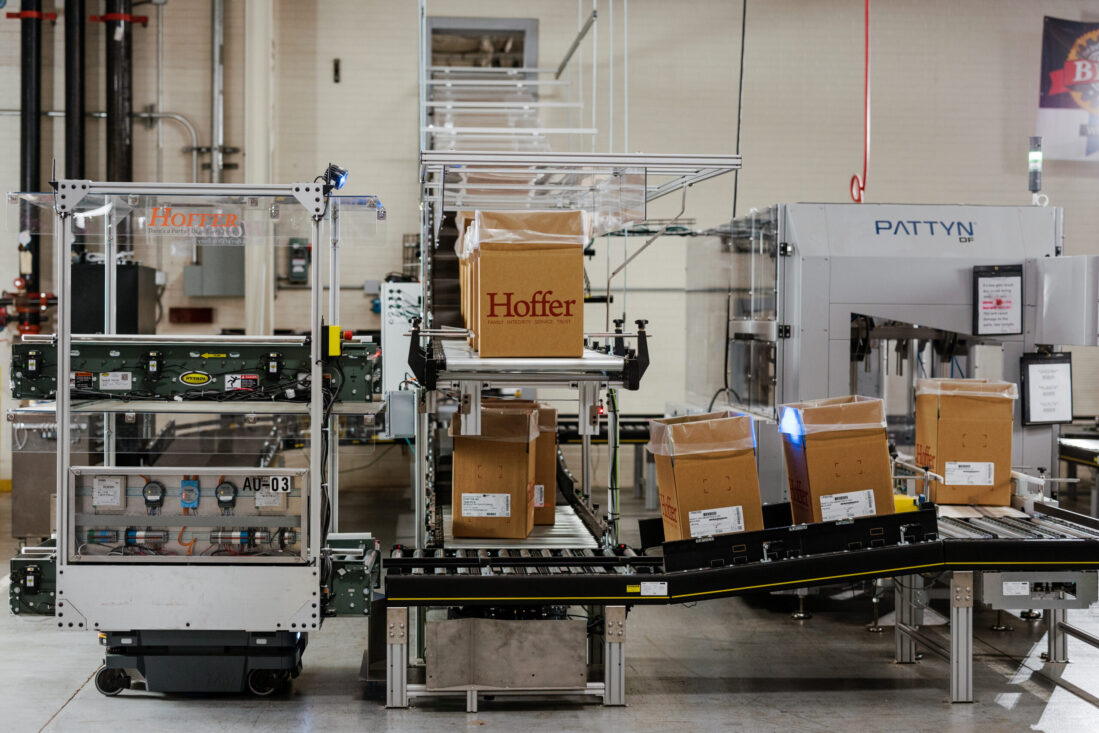
Automation that boosts throughput, stabilizes quality and lowers total cost.
Hoffer Plastics designs and integrates automation – from robotic part handling and vision inspection systems to cell-level PLC control and data capture – so every product moves from mold to pack-out with speed, precision and consistency.
Behind that automation is a cross-functional team focused on making production smarter, safer and more consistent. Automation has been part of Hoffer’s DNA for decades, evolving from simple part removal systems to fully integrated, closed-loop cells. Today, our automation team collaborates with tooling, molding and assembly experts to design solutions that keep every operation efficient, reliable and ready to scale.
Introduction
What Automation is and Why it’s Transforming Industries
Automation uses software, sensors, robotics and control systems to perform tasks with minimal human intervention. It reduces variation, accelerates cycle times, frees teams to focus on higher-value work and contributes to a safer work environment for all. In our operations, automation takes many forms, from vision inspection systems to autonomous mobile robots (AMRs), we’re seeking new ways to reduce variation, speed up cycle times and free our employees to focus on higher-value, more rewarding tasks.
Key Benefits: Efficiency, Cost Reduction and Scalability
- Efficiency: Faster cycle times and fewer bottlenecks
- Cost: Lower labor per unit and reduced scrap/rework
- Scalability: Cells that ramp from pilot to multi-shift production
Types of Automation
Workflow Automation
Business Process Automation
Business Automation
Industrial & Manufacturing Automation
Industrial Automation
Role in Factories, Production Lines and Supply Chains
Industrial automation keeps production running smoothly and consistently. It uses controls (PLC/HMI), sensors, motion systems and robotics to orchestrate consistent, traceable production across cells and lines. At Hoffer, these systems handle everything from part orientation to torque and leak testing – capturing data in real time for traceability and process control.
Examples of Robotics, Control Systems and IoT Integration
- 3-axis/6-axis robots with custom EOAT for de-gate, orientation and placement
- Vision systems for presence/position, color, measurement, cosmetic checks
I/O-linked torque/leak/functional tests with automatic pass/fail logic - IIoT data capture for OEE, SPC, alarms and predictive insights
Manufacturing Automation
Warehouse Automation
The Human Role in Automation
Automation Engineer
FAQs on Automation
Automation is the use of technology – software, sensors and machines – to perform tasks with minimal human intervention, improving speed, safety and consistency.
Robotic process automation is software “bots” that mimic user actions in digital systems (e.g., moving data between apps). In manufacturing, it complements physical automation and MES/ERP workflows.
Workflow automation is the automation of multi-step tasks (approvals, labeling, documentation) to reduce manual handoffs and errors.
Industrial automation is factory automation using PLCs, robots, sensors and vision to control equipment and ensure repeatable production at scale.
An automation engineer is a specialist who designs and integrates automated cells and controls, validates performance and links equipment data to quality and operations systems.
Injection molders use automation to connect every step of molding and assembly. At Hoffer, robotics handle part removal and placement, vision systems verify quality in real time, autonomous mobile robots move parts throughout the plant and data systems track performance across each Focused Factory. The result is consistent, high-quality parts produced with speed and precision.
Why Hoffer Plastics for Automation
For decades, Hoffer has invested in automation to advance quality, safety and efficiency across every part of production. What began with simple robotic part removal has evolved into a fully integrated automation program that drives molding, assembly, packaging and logistics. That continuous improvement mindset earned Hoffer the 2024 MAPP Innovation Award, recognizing leadership in automation and advanced manufacturing.
- Cell design & integration: Robotics/EOAT, conveyors, bowl feeders and safety.
- In-line quality: Vision inspection, functional/leak/torque testing with reject logic.
- Data & traceability: Lot/date/serial capture, SPC, dashboards and alerts.
- Validated processes: Documented windows (e.g., PPAP or IQ/OQ/PQ as required).
- Scalable throughput: Cells that expand from bridge runs to multi-cavity production.
At Hoffer, automation isn’t about replacing people. It’s about empowering them. Our engineers, operators and quality teams work together to build dependable systems that make product safer, smarter and more consistent. The result: faster launches, stable processes and confidence in every run.
Ready to automate?
Share part files, EAV, takt target, quality requirements, and packaging specs. We’ll propose a practical automation roadmap—from pilot to high-volume.
"*" indicates required fields